#include <pkcs12_kdf.h>
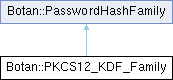
Public Member Functions | |
| std::unique_ptr< PasswordHash > | default_params () const override |
| std::unique_ptr< PasswordHash > | from_iterations (size_t iterations) const override |
| std::unique_ptr< PasswordHash > | from_params (size_t i1, size_t i2=0, size_t i3=0) const override |
| std::string | name () const override |
| PKCS12_KDF_Family (std::unique_ptr< HashFunction > hash, size_t id) | |
| std::unique_ptr< PasswordHash > | tune (size_t output_length, std::chrono::milliseconds msec, size_t max_memory_usage_mb=0, std::chrono::milliseconds tuning_msec=std::chrono::milliseconds(10)) const |
| std::unique_ptr< PasswordHash > | tune_params (size_t output_length, uint64_t desired_runtime_msec, std::optional< size_t > max_memory_usage_mb={}, uint64_t tuning_msec=10) const override |
Static Public Member Functions | |
| static std::unique_ptr< PasswordHashFamily > | create (std::string_view algo_spec, std::string_view provider="") |
| static std::unique_ptr< PasswordHashFamily > | create_or_throw (std::string_view algo_spec, std::string_view provider="") |
| static std::vector< std::string > | providers (std::string_view algo_spec) |
Detailed Description
Definition at line 71 of file pkcs12_kdf.h.
Constructor & Destructor Documentation
◆ PKCS12_KDF_Family()
| Botan::PKCS12_KDF_Family::PKCS12_KDF_Family | ( | std::unique_ptr< HashFunction > | hash, |
| size_t | id ) |
Definition at line 184 of file pkcs12_kdf.cpp.
References BOTAN_ARG_CHECK.
Member Function Documentation
◆ create()
|
staticinherited |
Create an instance based on a name If provider is empty then best available is chosen.
- Parameters
-
algo_spec algorithm name provider provider implementation to choose
- Returns
- a null pointer if the algo/provider combination cannot be found
Definition at line 60 of file pwdhash.cpp.
References BOTAN_UNUSED, Botan::HashFunction::create(), Botan::MessageAuthenticationCode::create(), Botan::fmt(), Botan::AlgorithmSpec::match(), and Botan::AlgorithmSpec::matches().
Referenced by botan_pwdhash(), botan_pwdhash_timed(), and create_or_throw().
◆ create_or_throw()
|
staticinherited |
Create an instance based on a name, or throw if the algo/provider combination cannot be found. If provider is empty then best available is chosen.
Definition at line 125 of file pwdhash.cpp.
References create().
Referenced by Botan::argon2(), Botan::argon2_check_pwhash(), Botan::argon2_generate_pwhash(), Botan::bcrypt_pbkdf(), Botan::CryptoBox::decrypt_bin(), Botan::CryptoBox::encrypt(), Botan::scrypt(), and Botan::scrypt().
◆ default_params()
|
overridevirtual |
Return some default parameter set for this PBKDF that should be good enough for most users. The value returned may change over time as processing power and attacks improve.
Implements Botan::PasswordHashFamily.
Definition at line 224 of file pkcs12_kdf.cpp.
◆ from_iterations()
|
overridevirtual |
Return a parameter chosen based on a rough approximation with the specified iteration count. The exact value this returns for a particular algorithm may change from over time. Think of it as an alternative to tune, where time is expressed in terms of PBKDF2 iterations rather than milliseconds.
Implements Botan::PasswordHashFamily.
Definition at line 228 of file pkcs12_kdf.cpp.
◆ from_params()
|
overridevirtual |
Create a password hash using some scheme specific format. Parameters are as follows:
- For PBKDF2, PGP-S2K, and Bcrypt-PBKDF, i1 is iterations
- Scrypt uses N, r, p for i{1-3}
- Argon2 family uses memory (in KB), iterations, and parallelism for i{1-3}
- PKCS12-KDF uses iterations for i1 (the hash and id are fixed by the family name, e.g. "PKCS12-KDF(SHA-256,1)")
All unneeded parameters should be set to 0 or left blank.
Implements Botan::PasswordHashFamily.
Definition at line 232 of file pkcs12_kdf.cpp.
◆ name()
|
overridevirtual |
Return the name of this password hash family
- Returns
- name of this PasswordHash
Implements Botan::PasswordHashFamily.
Definition at line 190 of file pkcs12_kdf.cpp.
References Botan::fmt().
◆ providers()
|
staticinherited |
List the providers available for a given password hash
- Returns
- list of available providers for this algorithm, empty if not available
Definition at line 133 of file pwdhash.cpp.
References Botan::probe_providers_of().
◆ tune()
|
inlineinherited |
Return a new parameter set tuned for this machine
Return a password hash instance tuned to run for approximately msec milliseconds when producing an output of length output_length. (Accuracy may vary, use the command line utility botan pbkdf_tune to check.)
The parameters will be selected to use at most max_memory_usage_mb megabytes of memory, or if left as zero any size is allowed.
This function works by running a short tuning loop to estimate the performance of the algorithm, then scaling the parameters appropriately to hit the target size. The length of time the tuning loop runs can be controlled using the tuning_msec parameter, though it always runs at least a few iterations and so may take longer for expensive functions.
The tuning loop measures the CPU time of the calling thread (where the platform supports this) and uses the fastest iteration observed, so the result reflects the capacity of the machine rather than its load at the moment of tuning. On a heavily loaded system the returned parameters may therefore take longer than requested.
- Parameters
-
output_length how long the output length will be msec the desired execution time in milliseconds max_memory_usage_mb some password hash functions can use a tunable amount of memory, in this case max_memory_usage limits the amount of RAM the returned parameters will require, in mebibytes (2**20 bytes). It may require some small amount above the request. Set to zero to place no limit at all. tuning_msec how long to run the tuning loop
TODO(Botan4) remove this
Definition at line 296 of file pwdhash.h.
References tune(), and tune_params().
Referenced by tune().
◆ tune_params()
|
overridevirtual |
Return a new parameter set tuned for this machine
Return a password hash instance tuned to run for approximately msec milliseconds when producing an output of length output_length. (Accuracy may vary, use the command line utility botan pbkdf_tune to check.)
The parameters will be selected to use at most max_memory_usage_mb megabytes of memory, or if left as zero any size is allowed.
This function works by running a short tuning loop to estimate the performance of the algorithm, then scaling the parameters appropriately to hit the target size. The length of time the tuning loop runs can be controlled using the tuning_msec parameter, though it always runs at least a few iterations and so may take longer for expensive functions.
The tuning loop measures the CPU time of the calling thread (where the platform supports this) and uses the fastest iteration observed, so the result reflects the capacity of the machine rather than its load at the moment of tuning. On a heavily loaded system the returned parameters may therefore take longer than requested.
- Parameters
-
output_length how long the output length will be desired_runtime_msec the desired execution time in milliseconds max_memory_usage_mb some password hash functions can use a tunable amount of memory, in this case max_memory_usage limits the amount of RAM the returned parameters will require, in mebibytes (2**20 bytes). It may require some small amount above the request. Set to nullopt to place no limit at all. tuning_msec how long to run the tuning loop
Implements Botan::PasswordHashFamily.
Definition at line 194 of file pkcs12_kdf.cpp.
References Botan::measure_cost().
The documentation for this class was generated from the following files:
- src/lib/pbkdf/pkcs12_kdf/pkcs12_kdf.h
- src/lib/pbkdf/pkcs12_kdf/pkcs12_kdf.cpp
Generated by
 1.16.1